
Bengaluru (Karnataka) [India], August 26: There is a particular kind of stubbornness that separates companies that last from companies that merely survive. It is not the stubbornness of refusing to change. It is the stubbornness of refusing to walk away from a problem, even when the solution keeps demanding a completely different shape.
Kidvento Education and Research Private Limited was founded in Mysuru in 2017 by Sumanth Prabhu MG and Nikhil Bhaskar. What started as a hands-on science learning program inside school classrooms has grown into one of India’s most comprehensive education ecosystems, spanning everything from AI education and skill learning to innovation infrastructure, career guidance, and digital art centres — the kind of breadth that takes a decade of classroom-level observation to earn. Today, that ecosystem includes Ulipsu, the company’s skill-learning platform, reaching students across India, the Middle East, and beyond. The company did not grow this way because of a single breakthrough. It grew this way because it kept asking the question most education companies avoid: not what can we build, but what will actually work — inside real classrooms, for real teachers, with real students.
Starting From the Classroom Floor
In the early years, Kidvento worked directly inside schools, not above them. Core team members were not building products from a boardroom — they were observing teachers, watching students disengage, and understanding from ground level why learning so often failed to stick. Their first offering, Pro-Science, brought experiential science learning into classrooms in a hands-on, curriculum-linked way. Alongside it came Catalyst, teaching tools for Science, Math, and English, and Tinker Box, a STEM exploration program. What these programs gave Kidvento was not revenue — not at first. What they gave was a detailed, unfiltered understanding of how schools actually work. That understanding became the foundation for everything that followed.
Building Infrastructure at Scale
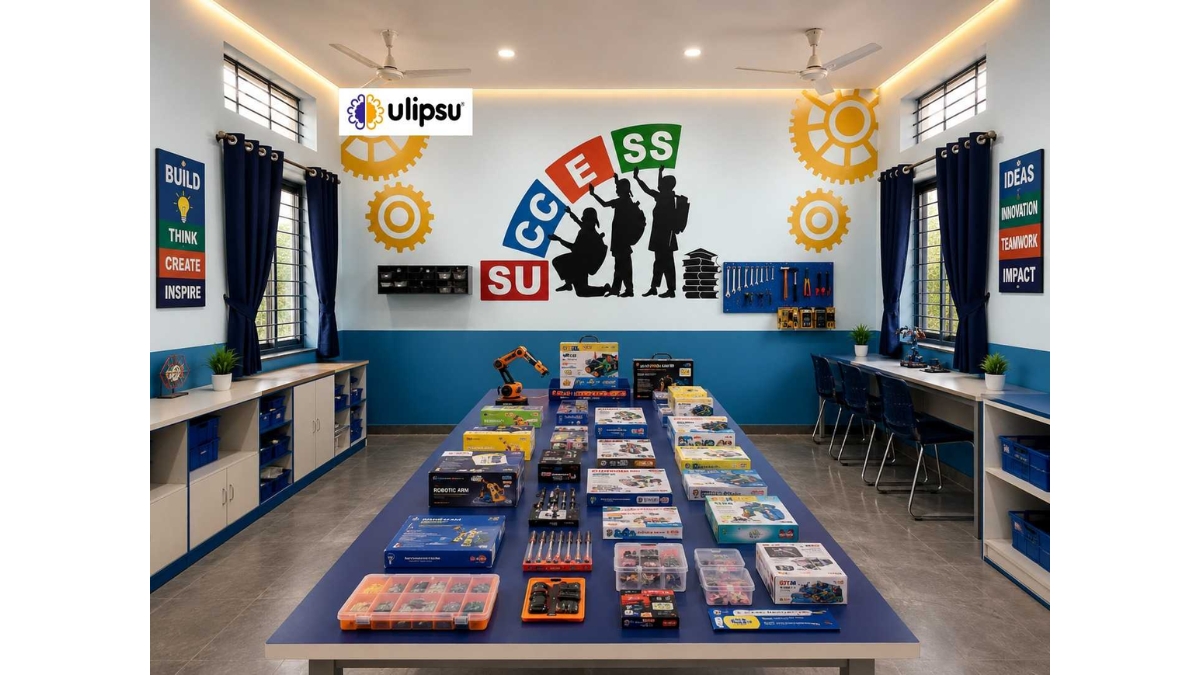
As relationships with schools deepened, the company identified a second gap. Schools did not just lack engaging content — many lacked the physical infrastructure to support future-ready education at all. Kidvento became one of India’s serious implementers of innovation infrastructure, establishing over 350 technology and innovation labs nationwide, setting up more than 250 Atal Tinkering Labs under NITI Aayog, over 100 ATLs under PM SHRI schools, and over 100 Innovation Labs under the Department of Science and Technology, Karnataka Government. This phase revealed something that would define the company going forward: It was not just a content or technology company. It was an execution company — one that could design a vision for future-ready learning and actually put it in place on the ground.
The Insight That Changed Everything
Somewhere in the middle of building labs and training teachers, the company arrived at a realisation that would fundamentally reshape it. Schools were doing a reasonable job of preparing students for examinations. They were not preparing students for the skills that would define careers in the decades ahead. Skill learning was fragmented, inconsistent, extracurricular at best, and absent at worst. This was not a small gap. It was a structural failure of the education system, hiding in plain sight. The response was Ulipsu.
What Ulipsu Actually Is
Ulipsu is an attempt to do for skill education what the traditional school system did for academic education: build a structured, research-backed, globally aligned curriculum that belongs inside the regular school timetable and delivers measurable outcomes. The platform covers more than 17 skill domains — broad enough that a student interested in space technology and one drawn to coding are both working within the same structured framework, building portfolios and earning internationally recognised certificates along the way. The curriculum is aligned with India’s NEP 2020 and NCF 2023, accredited by ISTE across 127 countries, and certified by STEM.org. From Grade 5 onwards, students complete a Holland Code-based career interest assessment enabling early career awareness. Parents, teachers, and schools get real-time dashboards tracking engagement and progress.
The Numbers Behind the Mission
The numbers tell part of the story. Ulipsu is now active in more than 350 schools across 12 Indian states, reaching over 1 million students — more than 300,000 of whom have completed structured project work. Across all its verticals, Kidvento has partnered with over 850 schools in total. But the figure that matters most to the founders is different: in FY 2025–26, Kidvento became EBITDA positive for the first time after their fundraising in 2022 — building on $6 million raised to date, and entering FY 2026–27 with 2.5 times bookings growth. In an EdTech sector littered with growth stories that never converted to unit economics, that is the number that signals something real has been built.
“Growth in education is never about reaching more schools alone. It is about earning the trust to become part of a school’s long-term vision. Every partnership we build is rooted in one belief — that when schools succeed in preparing students for the future, sustainable growth follows naturally.”
— Kiran, Chief Revenue Officer, Kidvento
Resilience Through Change
COVID-19 forced an overnight rethink. Kidvento’s earliest products were built around in-classroom delivery — a model that became impossible in 2020. Rather than waiting for schools to reopen, the team digitised its curriculum and shifted to remote delivery, an experience that directly shaped Ulipsu’s architecture. When NEP 2020 and NCF 2023 repositioned skill development from enrichment to core mandate, Kidvento rebuilt and revalidated significant portions of the platform to meet new regulatory expectations — deepening its credibility with government-affiliated schools in the process. Through volatile EdTech funding cycles, the company prioritised school retention, recurring revenue, and multi-year government contracts over growth at the expense of unit economics. That discipline is what made EBITDA positivity possible.
The Team Behind the Journey
Kidvento’s team grew from a handful of people working in classrooms. The culture reflects that origin — people were hired for curiosity and willingness to work alongside teachers and students, not credentials alone. Many early team members now lead product, business, and implementation functions, carrying institutional knowledge of what works in schools into every product decision.
“When we started, we were in classrooms, not boardrooms, and that hasn’t really changed,” says Sushruth Tenkod, Chief Business Officer, Kidvento. “What has changed is the scale. We now work with more than 800 partner schools, and every one of those relationships started the same way — by listening to what a school actually needed, not what we assumed they needed.”
What Comes Next
Kidvento’s roadmap through 2030 runs along five directions: global expansion into Africa, Southeast Asia, and the Middle East; deeper government partnerships as NEP 2020 creates structural demand for skill curriculum; AI-first education through its ARISE initiative; a complete career and employability ecosystem connecting skill discovery to employment outcomes; and sustainable, profitable growth that allows international scale without perpetual external subsidy.
In nine years, Kidvento has built, rebuilt, and scaled learning solutions spanning nearly every dimension of school education — without abandoning its original purpose. Its greatest achievement is not any single product or milestone. It is that after nearly a decade in one of the most complicated sectors in the world, it remains the same company it set out to be: one that genuinely believes schools should prepare students not just for exams, but for life.