
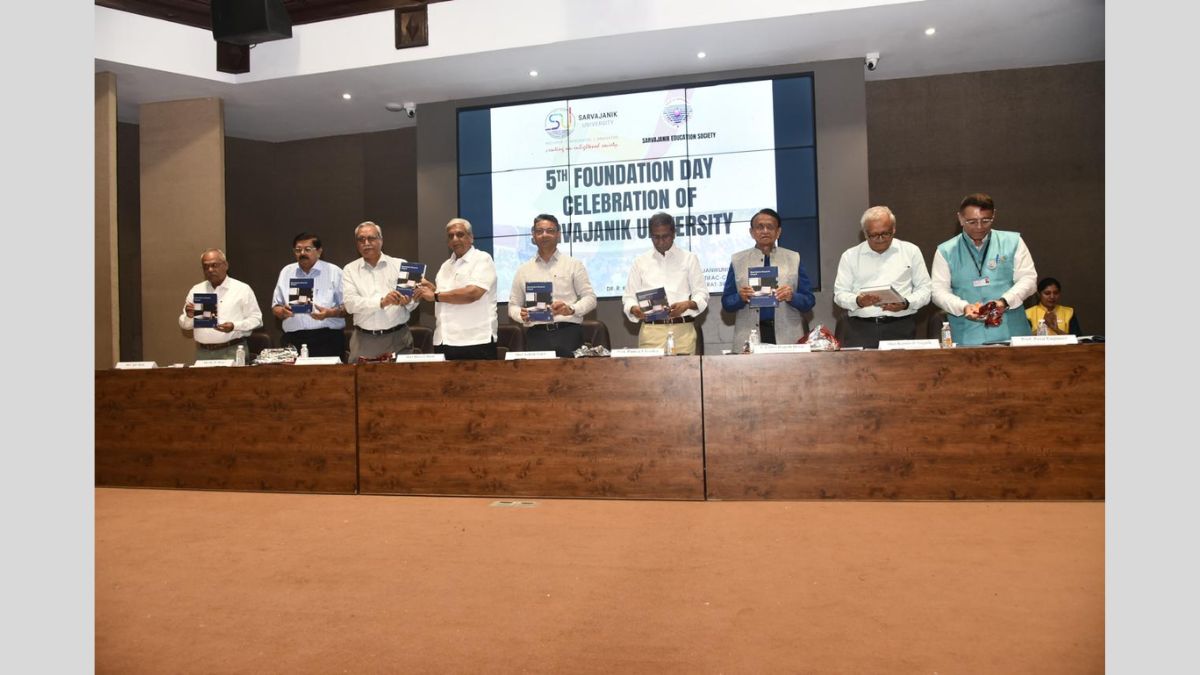
It is an absolute privilege to introduce the book Quantitative Research Using R, co-authored by our Provost, Prof. Kiran Pandya, alongside his former doctoral student, Dr. Smruti Bulsari. Hearing the remarkable journey that led the authors to this milestone is truly inspiring. For those unfamiliar with “R,” it is a powerful, free, and open-source software widely used by statisticians for data analysis and modeling—though its full capabilities extend far beyond that.
Their journey with R began nearly two decades ago, around 2007–08, at a time when the software was virtually unknown. There was no user-friendly RStudio interface, nor were there online troubleshooting communities like Stack Overflow or R-bloggers. The authors relied almost entirely on the software’s built-in “Help” files (the classic F1 key). Operating under the resource constraints of an early R 1.x version, they chose R because it was non-proprietary—a decision born of necessity that soon turned into a long-term passion.
At the time, most standard textbooks on the subject were international editions with prohibitive pricing for the Indian subcontinent. Driven by a desire to bridge this gap, the authors set out to create an accessible resource for beginners in both statistics and coding. Their efforts culminated in a 2018 book published by Sage, which received an overwhelming global response across India, the US, UK, and Australia. When Sage later closed its textbook division in India and returned the copyrights, Routledge—recognising the book’s immense success—approached the authors.

Rather than simply expanding the original text, Prof. Pandya and Dr. Bulsari chose to completely revamp it with a distinct research orientation. The resulting volume, Quantitative Research Using R, marks a significant paradigm shift from teaching isolated statistical techniques to guiding readers through the broader process of quantitative research.
The early chapters lay a solid theoretical foundation in data types, sampling, and hypothesis testing, brought to life through multi-disciplinary examples. Each chapter features a fully worked-out case study complete with executable R code and detailed interpretations of the outputs. This makes the book uniquely versatile, catering equally to novices, seasoned researchers, and advanced statisticians. It seamlessly bridges the domains of research methodology, applied statistics, and R programming.
While the mid-sections cover practical hypothesis testing, correlation, analysis of covariance, and regression models (including logit and probit), the later chapters delve into advanced multivariate techniques such as factor analysis, multidimensional scaling, cluster analysis, survival analysis, and sensitivity analysis.
The book has already garnered prestigious international endorsements from scholars at the London School of Economics, the University of Cambridge, the University of Sussex (including renowned econometrician Professor Emeritus Andrew Newell), as well as institutions across India and Saudi Arabia. Notably, the University of Oxford has already acquired the e-book with multi-user access for its scholars.
I do not doubt that this text will become a cornerstone in academic research, and I wish the authors tremendous success.